


A landmark statewide economic impact study released on June 9th, 2026 by Parks and Trails NY finds that New York’s 750-mile Empire State Trail is delivering transformative economic, health, and environmental benefits to communities across the state. According to the study, the trail system is generating $1.87 billion in economic activity while connecting millions of residents and visitors to safe outdoor recreation.
In addition to the approximate $1.87 billion in total economic output each year, the report finds the Trail supports 9,680 jobs statewide, produces $640.9 million in annual employee earnings, and generates $206 million in annual state and local tax revenue.
According to the report, every $1 invested in the Empire State Trail generates $5.43 in sales revenue, with off-road trail segments producing four times the economic impact of on-road segments. Each off-road mile contributes $3.9 million in annual economic output while also supporting local jobs and tax revenues.
Businesses located near the Trail report significant economic benefits:
- Nearly one in four business owners surveyed cited the Trail as a deciding factor in their business location.
- More than 40% of businesses are investing in bicycle amenities, trail access improvements, and visitor accommodations.
- Businesses surveyed reported that trail-related visitors account for 26.2% of annual sales.
The study also found that proximity to the Trail increases residential property values in many communities. Single-family homes on 0.25–0.5 acre lots near the Trail command a 14.3% premium, averaging $51,000 higher than comparable properties. Residences on 0.5–1 acre lots see a 3.6% value premium, reinforcing the Trail’s role as a vital asset.
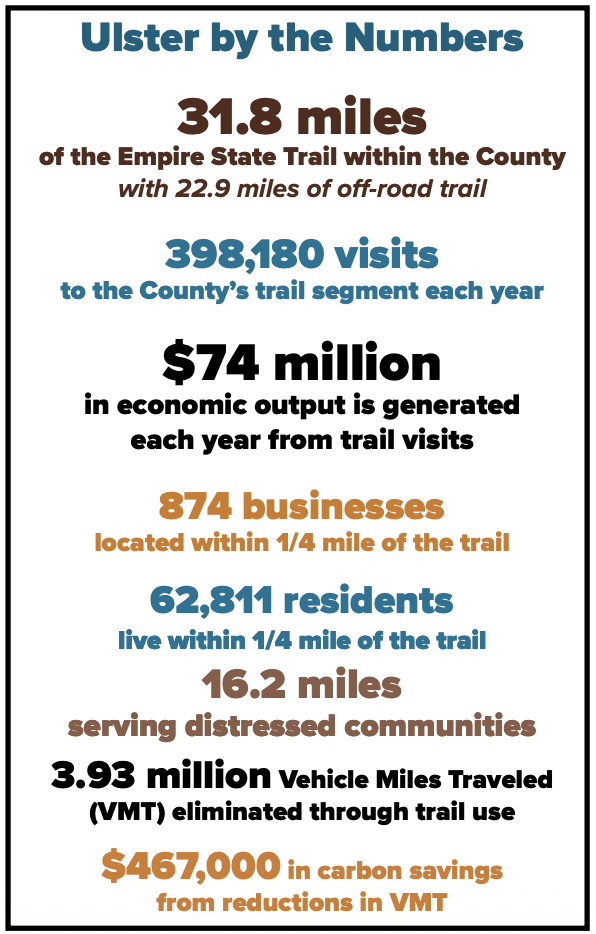
In Ulster County, the Empire State Trail runs 31.8 miles from the Walkway Over the Hudson in the south to Kingston and the Kingston-Rhinecliff bridge in the north, including 16.2 miles through distressed communities. The trail is primarily off-road, consisting of 22.9 miles of off-road pathways.
In the county, the trail attracts 398,180 visitors per year, who spend an average of $19.61 per visit, for a total of $74 million in annual economic output. Spending is determined by population density along trail segments. The trail provides $3,194,000 in health benefits to residents. The trail has also eliminated 3,929,000 in Vehicles Miles Traveled (VMT) and saved $467,000 in emissions.
